Don't Play with My Hair
An instrument that reads hair by touch and by camera, driving a synthesizer whose wavetables come from a CT scan of hair.
- Role
- Composer, instrument builder
- When
- 2024–present
- Built with
- Teensy 4.1 · MPR121 · vvvv · OpenCV · Houdini · Python · PlugData · Max/MSP
Don’t Play with My Hair makes hair the instrument. It is Movement III, FLESH, of Organic Memory (Triptych), the three-instrument composition at the center of my dissertation, and the most intimate of the three: the shared rhythmic cell from When Johnny Comes Marching Home appears here at a human tempo, as touches and pulls a listener can follow.
Schools and workplaces police Black hair. Barbershops and the care knowledge passed between generations make it a site of intimacy too. My argument about this instrument concerns consent, in two registers at once: hands that reach for my head without asking, and computer vision systems that extract from a body without asking. When a vision system fails to read Black hair, I treat the failure as one of design.
Two ways of reading hair
The instrument reads hair by touch and by camera.
For touch, a Teensy 4.1 drives MPR121 capacitive sensor boards with electrode layouts I designed for hair. Each electrode reports a charge-transfer rate. On the Teensy, thresholding and velocity tracking clean up that signal before it goes over serial to Max/MSP, where the quality, speed and direction of contact set layered synthesis parameters.
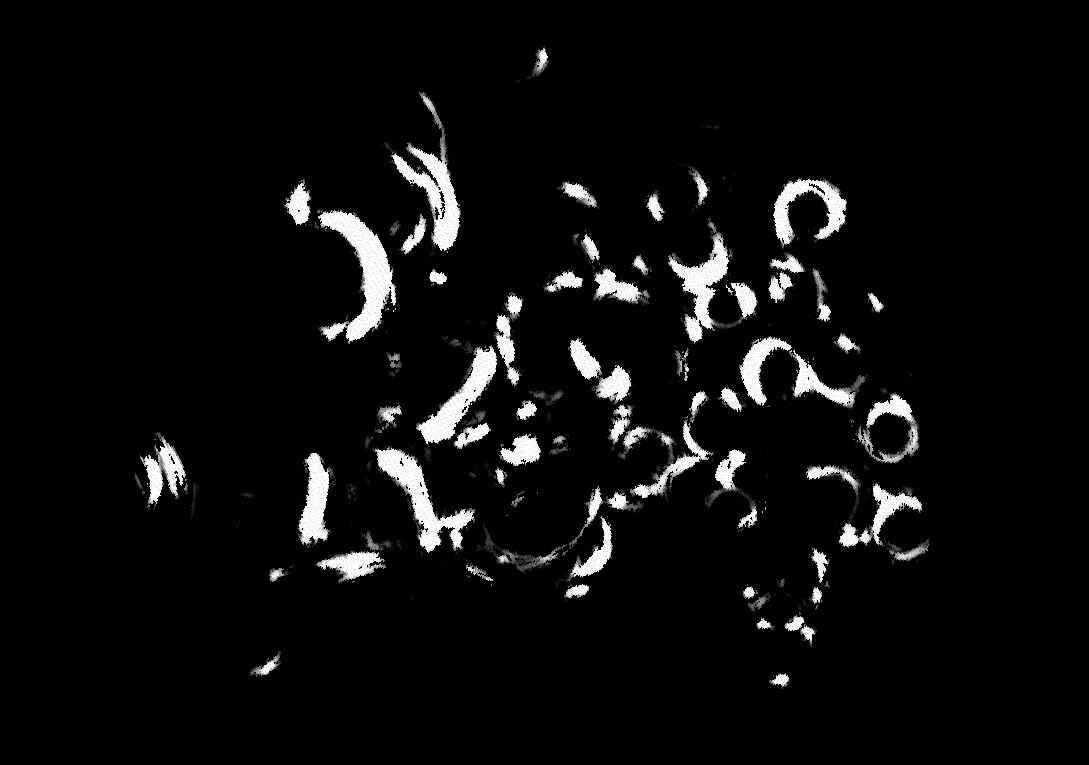
For vision, vvvv and OpenCV extract contours, blobs and keypoints from video of hair, and Max/MSP maps those features onto the synthesis. This path works from recorded video for now. Capturing subtle gestures live, a slow twist or fingers drawn through, is the open problem.
The HairSynth
Under both paths is a synthesizer whose source material comes from hair itself. Starting from a CT scan of a curly afro, I rendered the volume as a VDB in Houdini and converted it to a point cloud. A Python script I wrote extracts features from the points and writes them out as 1,024-sample WAV files, and a custom PlugData wavetable synthesizer plays them. Replacing the scan with a capture of my own hair is the next step.
The output buzzed. I had not planned for it to sound like hair clippers, and I kept the sound: that clipper hum is now this movement’s version of the low drone shared by all three movements of the triptych.
None of the mappings are one-to-one. More texture does not mean louder. I tuned them to what I know about touching hair and about the sound of a barbershop.
Video
Don't Play with My Hair: Documentation